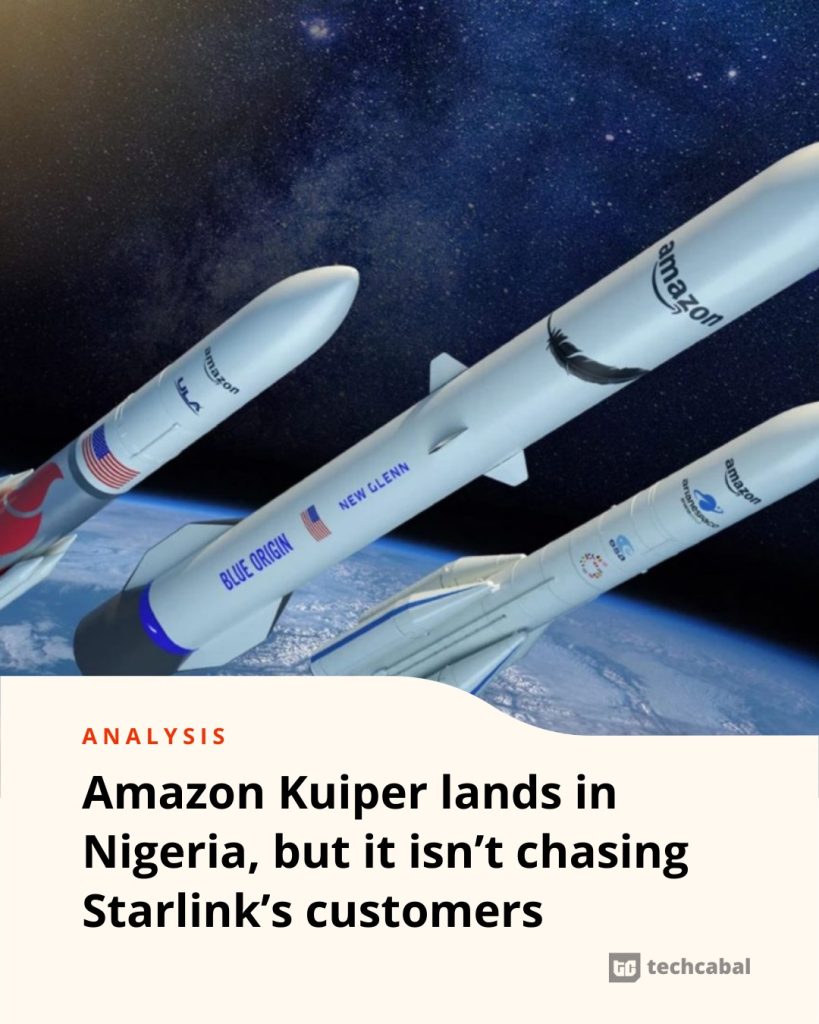
In early 2026, Nigeria’s satellite internet landscape officially entered a new phase. The Nigerian Communications Commission granted Amazon’s Project Kuiper a seven-year licence to operate its low-Earth orbit satellite broadband service across the country, a milestone that puts Nigeria firmly on the map for next-generation connectivity. This comes as the nation continues to open its skies to space-based internet providers, joining global markets experimenting with satellite broadband.
On the surface, it’s easy to assume this is a direct showdown with Starlink, the SpaceX-owned satellite internet service that has been operating in Nigeria since 2023. Starlink’s model is simple and immediately visible: users buy the hardware, plug it in, and get high-speed broadband in places where fibre or fixed networks don’t reach. That accessibility helped Starlink grow into one of Nigeria’s largest internet providers, attracting tens of thousands of subscribers by offering reliable speeds in underserved areas.
But industry experts are clear that Amazon’s strategy is not focused on capturing the same set of customers immediately. Kuiper’s presence in Nigeria is part of a broader global rollout that includes a planned constellation of more than 3,200 satellites. For Nigeria specifically, Amazon is expected to adopt a different approach from Starlink’s consumer-centric play. Instead of marketing directly to households first, Kuiper is positioning itself as part of deeper infrastructure layers such as back haul services, connectivity for enterprises, and integration with corporate cloud systems through Amazon Web Services.
The distinction is important. Starlink’s growth in Nigeria has come from users who need direct internet access in places where fibre and cellular broadband are weak or unavailable. Kuiper, by contrast, sits closer to the backbone of connectivity. By tying satellite links directly into AWS tools used by businesses and governments, Amazon is creating a product that can improve network resilience, reduce latency for cloud workloads, and support data-heavy enterprise operations. Kuiper is less about selling internet to individuals and more about enabling enterprise-scale connectivity and cloud integration.
That does not mean there will never be overlap. Analysts expect a hybrid market in Nigeria where both services grow, but in complementary ways. Satellite broadband demand remains strong, especially in areas where traditional networks struggle, and having multiple providers can expand choice. Regulators and industry players are also pushing for frameworks that separate infrastructure providers from last-mile access services. This could allow global satellite operators like Kuiper to focus on capacity and back haul local ISPs handle customer connections and service delivery.
The broader conversation around this development reflects both optimism and realism. Opening the skies to multiple satellite networks signals that Nigeria is ready to embrace alternative connectivity solutions. Affordability, access points, and local infrastructure still determine whether rural and low-income communities actually benefit. Satellite solutions, whether from Starlink or Kuiper, may expand broadband availability, but everyday Nigerians will still rely on strong local networks to reach it effectively.
In essence, Project Kuiper’s arrival is not a sign that Starlink is about to be unseated, but rather that the market is maturing. Satellite internet is becoming a layered ecosystem where global infrastructure and local access can grow together. For businesses, governments, and tech observers, what matters now is not a zero-sum race, but how these technologies expand real connectivity across Nigeria’s digital economy.
Leave a Reply