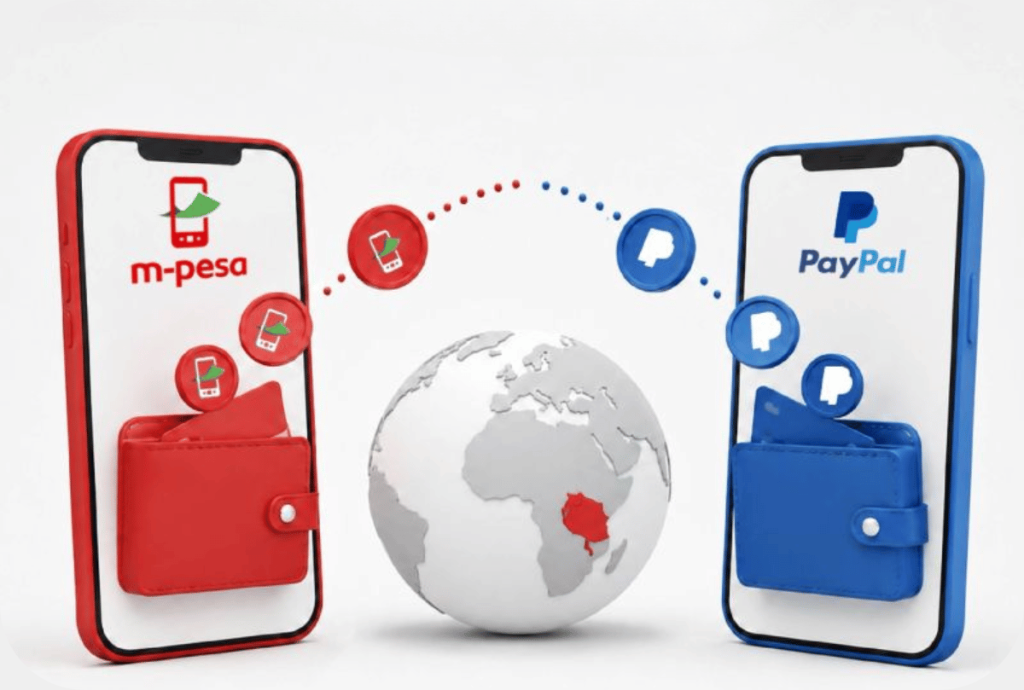
Digital payments in Africa are increasingly being shaped by a simple demand: moving money across borders without friction, delays, or unnecessary intermediaries.
That demand is at the center of a reported partnership between Vodacom Tanzania and PayPal, designed to connect PayPal users directly with M-Pesa wallets through the M-Pesa Super App. The integration aims to make it easier for users to send and receive money between PayPal accounts and mobile money systems, extending M-Pesa’s role beyond domestic transactions into global payment flows.
M-Pesa has long operated as one of Africa’s most widely used mobile money systems, particularly in East Africa, where it has become embedded in everyday commerce. Built initially for basic peer-to-peer transfers and merchant payments, it has gradually evolved into a broader financial infrastructure layer used for savings, bill payments, business transactions, and cross-border remittances. The push to integrate with global platforms like PayPal reflects a broader industry shift toward interoperability between local mobile money systems and international digital finance networks.
The reported integration through the M-Pesa Super App suggests a system where users could potentially move funds between PayPal balances and mobile money wallets without relying on traditional banking rails as the primary intermediary. For freelancers, small business owners, and digital workers in Tanzania, this type of linkage is particularly relevant. Many already earn income from international platforms but face friction when converting foreign payments into usable local currency through banks or third-party services. Reducing those steps can significantly improve liquidity and access to earnings.
The impact extends beyond individual users. Cross-border payment connectivity is one of the most persistent infrastructure gaps in African digital finance. While domestic mobile money ecosystems are highly advanced, international interoperability remains fragmented. If integrations like this scale, they could strengthen e-commerce participation, improve remittance flows, and reduce transaction costs for businesses operating between Africa and global markets. At the same time, they place more pressure on telecom operators, fintech platforms, and regulators to ensure compliance around anti-money laundering rules, identity verification, and currency controls.
What makes this partnership particularly notable is the direction of influence. For years, African payment systems were largely seen as endpoints receiving money from global platforms. Now, systems like M-Pesa are increasingly being treated as financial infrastructure in their own right, capable of integrating with global giants on more equal technical footing. But the real test will be execution: reliability, pricing, settlement speed, and how smoothly funds move in practice across systems that were not originally designed to interoperate at this level.
The bigger question is whether this kind of integration marks the beginning of a truly connected global mobile money ecosystem or remains a set of isolated partnerships that work well on paper but unevenly in practice. For users in Tanzania and similar markets, the value will ultimately depend less on the announcement itself and more on whether sending money across borders becomes as seamless as sending it within the same country.
Leave a Reply