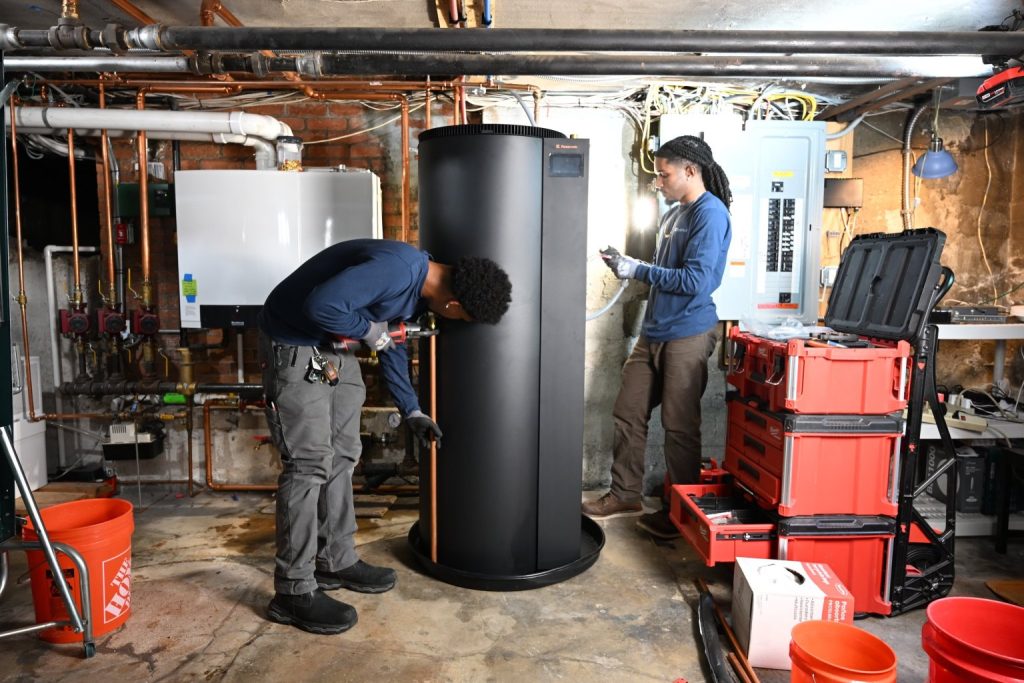
Reservoir, a Boston-based climate technology startup, has raised $8 million in seed funding to develop smart heat-pump water heaters designed to make home electrification more attractive while also helping utilities manage electricity demand. The round was led by Asymmetric Capital Partners, with participation from Founder Collective and MCJ.
Founded by Luke Winston-Almanzar, Gabriel Parisi-Amon and Jake Felser, Reservoir is approaching the water heater as more than a household appliance. The company wants to turn it into an intelligent energy-management device that can provide comfort for homeowners while functioning as a flexible resource for the electricity grid.
At the centre of Reservoir’s technology is a heat-pump water heater combined with sensors, software and industrial controls. Rather than simply heating water whenever the temperature falls, the system can learn household usage patterns and decide when to consume electricity. It can prioritise periods when power is cheaper or when renewable energy is more readily available.
This capability could become increasingly important as electricity grids add more intermittent renewable energy. Solar and wind generation can fluctuate throughout the day, while electricity demand can spike during peak periods. Reservoir believes thousands of connected water heaters could collectively shift consumption without requiring households to sacrifice hot-water availability.
The company describes its technology as a kind of “thermal battery.” Instead of storing electricity in a conventional battery, Reservoir stores energy as heated water and can delay or accelerate heating depending on grid conditions. During a recent demonstration with home-energy monitoring company Sense, Reservoir showed how its water heaters could automatically reduce electricity consumption when local grid infrastructure was under strain.
For consumers, the proposition is equally focused on convenience and savings. Reservoir says its system can use lower-cost electricity, coordinate with rooftop solar and adapt to household behaviour. Its current products also include features aimed at reducing leaks, preventing bacterial growth and improving hot-water availability.
The startup is also tackling one of the biggest barriers to heat-pump adoption: the perception that efficient appliances require complicated installations or involve compromises in performance. Reservoir says its products are designed as direct replacements for many existing water heaters, with installation handled by its own certified team in its initial markets.
The new funding will give Reservoir resources to expand manufacturing, improve its technology and grow its market presence. The company is currently installing systems in the Boston metropolitan area and has indicated plans to expand beyond its initial New England footprint.
Reservoir’s strategy reflects a broader shift in climate technology: decarbonisation does not necessarily require consumers to choose between sustainability and convenience. By making an everyday appliance smarter, the company hopes to create benefits for homeowners, utilities and the environment simultaneously.
If Reservoir succeeds, the humble water heater could become an important component of the future smart grid—providing hot showers for households while quietly helping electricity networks become cleaner, cheaper and more resilient.
Leave a Reply