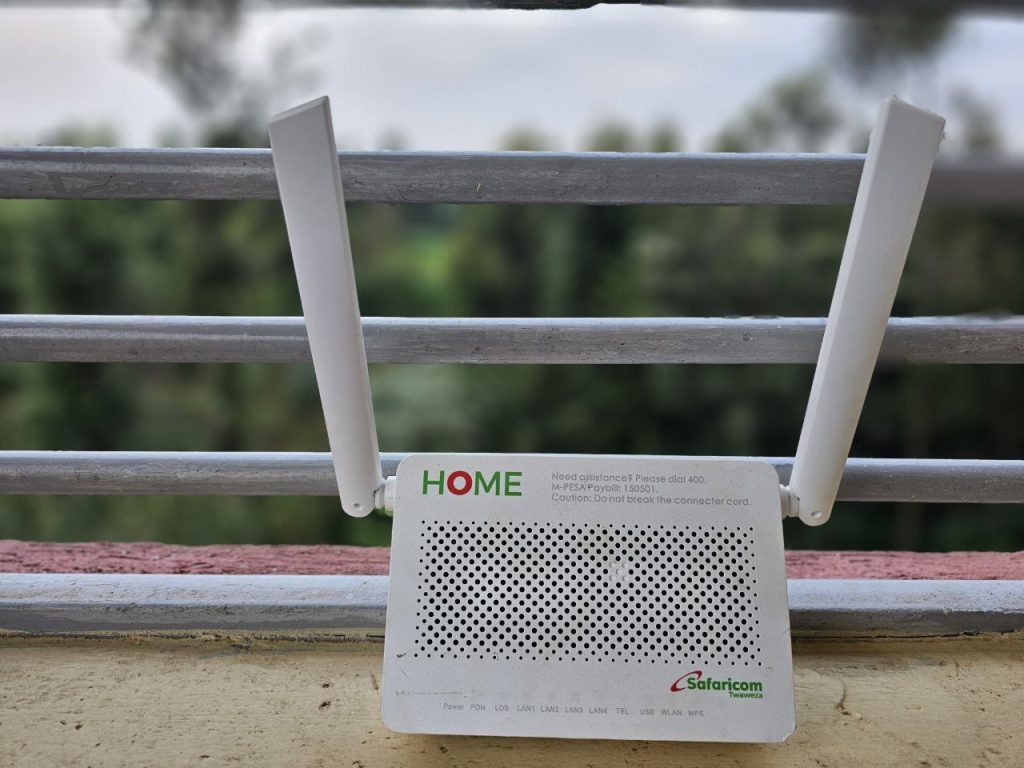
Safaricom has crossed a major milestone in Kenya’s broadband market, surpassing one million fixed internet subscriptions and strengthening its position as the country’s largest fixed internet provider. But reaching the milestone may prove easier than keeping those customers satisfied as competition, technology and consumer expectations continue to rise.
Data from the Communications Authority of Kenya shows that Safaricom had 1,024,950 fixed internet subscriptions by the end of June 2026, giving it a 36.1% share of Kenya’s 2.84 million fixed internet market. The figure represents a 39.3% increase from the 735,749 subscriptions recorded a year earlier, meaning the company added roughly 289,000 connections in 12 months.
The growth is part of a much larger expansion in Kenya’s broadband market. Total fixed internet subscriptions increased 32.4% year-on-year, as households and businesses increasingly depend on connectivity for streaming, remote work, education, digital commerce and other online services. Fibre remained the dominant technology, with 1.57 million subscriptions, while terrestrial wireless connections grew even faster, rising 42.9%.
Safaricom’s achievement is particularly significant because its fixed internet business has expanded dramatically over the past decade. The company had only 40,015 fixed subscriptions in September 2017 and 269,397 in June 2021. Its latest numbers therefore represent a substantial transformation of its broadband business.
However, one million connections also raises the stakes.
Safaricom is no longer competing simply to acquire broadband customers. It must now retain a large and increasingly demanding customer base while defending its position against established fibre providers, wireless operators and satellite internet companies.
The competitive environment is already changing. Jamii Telecommunications had 541,003 subscriptions by June, while Wananchi Group had 294,375 and Ahadi Wireless reached 270,586. Starlink, although still much smaller, increased its subscriptions by 58.5% year-on-year to 27,616.
Speed and pricing are becoming important battlegrounds. Safaricom increased speeds on several Home Fibre packages in April without corresponding monthly price increases, while Zuku also introduced speed upgrades. Safaricom’s current Home Fibre portfolio ranges from 40Mbps to 1Gbps, although its plans are subject to fair-usage limits.
The next challenge is therefore about more than adding another million connections. It is about network reliability, customer service, affordability and consistent performance as usage increases.
For Safaricom, the one-million mark is a sign that home internet has become a major growth engine. The harder task now is turning that scale into a durable broadband advantage while Kenya’s rapidly expanding market gives customers more alternatives.
The milestone closes one chapter for Safaricom. The competition to keep those million connections begins the next one.
Leave a Reply