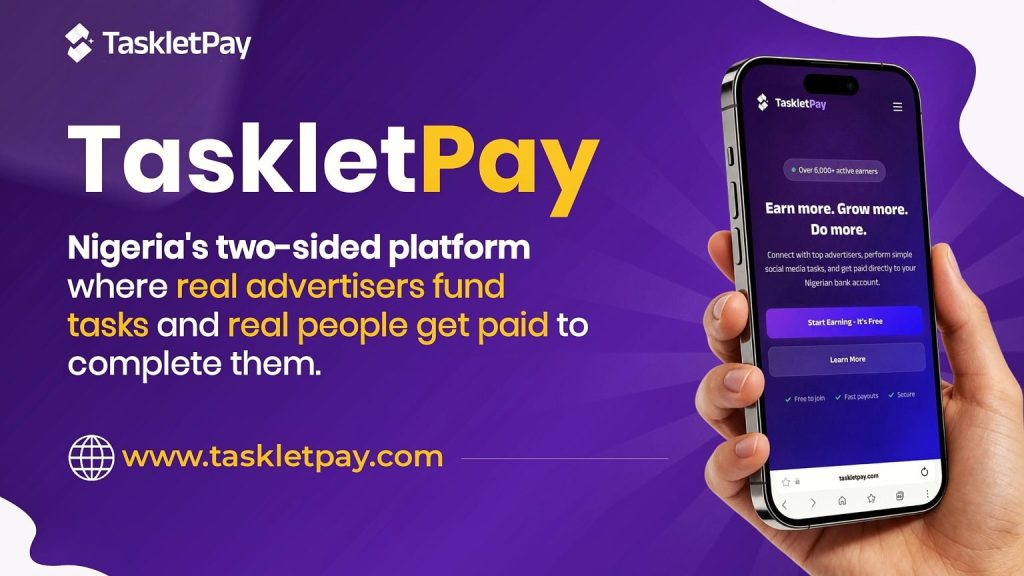
Nigeria’s digital economy is creating a new category of work: small, task-based jobs that allow people to earn money by completing specific activities online rather than taking on a traditional full-time role.
These platforms sit between freelancing and casual digital work. Instead of bidding for long-term projects or building a professional portfolio, users can complete individual tasks such as data entry, surveys, app testing, content verification, transcription, social-media activities and artificial-intelligence data labelling.
The model is gaining attention because of its relatively low entry barrier. Some platforms allow users to begin with a smartphone and basic digital skills, making task-based work accessible to people who may not yet have the experience required to compete on conventional freelance marketplaces.
Nigeria is also seeing the emergence of locally focused platforms. NiYA Gigs, backed by the Federal Ministry of Youth Development, describes itself as a national gateway connecting Nigerian youths with freelance opportunities and digital work. Its marketplace includes opportunities ranging from video editing to software recruitment.
Other platforms are focused more narrowly on microtasks. Clickworker, Remotasks, CrowdGen by Appen and similar services connect workers with projects involving AI training, research, transcription, image labelling and other digital activities. Availability and payment arrangements vary by platform and location.
The attraction is flexibility. A person can potentially work around school, another job or other responsibilities and choose tasks based on availability. For businesses, the model provides access to a distributed workforce that can complete thousands of small activities without requiring conventional employment arrangements.
But the growth of task-based earning also exposes some of the weaknesses of the digital gig economy.
Task availability can fluctuate significantly, meaning workers cannot necessarily depend on the platforms for predictable monthly income. Payment methods can also create friction for Nigerian users, particularly when international platforms rely on services such as Payoneer or other cross-border payment systems.
There is also a major difference between task-based earning and skilled freelancing. Completing a series of small tasks may generate additional income, but it does not automatically provide the same earning potential or career progression as developing expertise in areas such as software engineering, design, writing or professional consulting.
Trust is another important issue. The popularity of online earning has created an environment where legitimate platforms compete with fraudulent schemes. Nigerian users have encountered numerous offers promising easy money, making transparent payment processes, clear task requirements and verifiable business models increasingly important.
Some newer Nigerian platforms are responding by using escrow-style systems. FiniTasks, for example, says advertisers fund tasks before workers complete them, while submissions are reviewed before payment is released.
The larger trend reflects a changing relationship between technology and employment in Nigeria. Digital platforms are breaking work into smaller units and allowing people to participate from virtually anywhere with an internet connection.
For workers, however, the opportunity comes with an important caveat: task-based platforms are generally better viewed as flexible sources of supplementary income than guaranteed salaries. Earnings depend on task supply, eligibility, completion rates and platform policies.
As Nigeria’s digital workforce expands, the next stage of the sector will likely depend on whether these platforms can move beyond simple online tasks and create more reliable pathways from micro-work to higher-value digital employment.
Leave a Reply