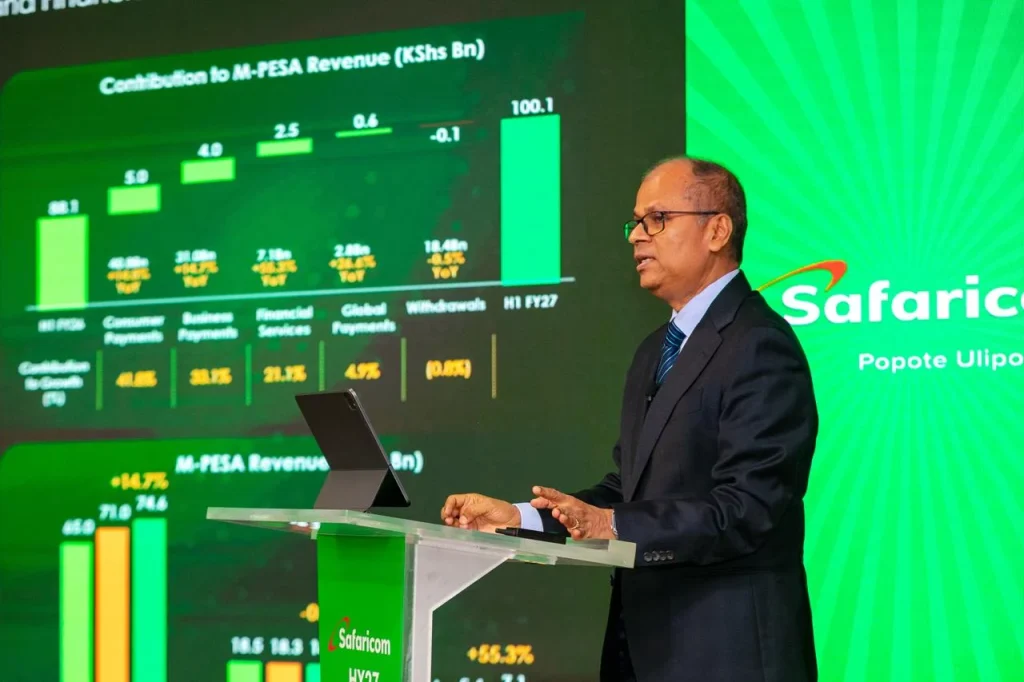
Safaricom is strengthening its position in Kenya’s digital lending market as growing demand for short-term mobile credit drives higher revenue from its M-PESA overdraft service, Fuliza.
The telecommunications company generated KES 4.9 billion (approximately $38 million) from Fuliza in the six months to September 2026, representing an 86 per cent increase compared with the corresponding period last year. The growth highlights the increasing importance of digital lending to Safaricom’s financial services business.
According to figures presented at the company’s investor briefing in Nairobi, Fuliza’s borrower base nearly doubled to 17.2 million customers, reflecting rising adoption of instant credit among M-PESA users.
Launched in 2019, Fuliza allows customers to complete mobile money transactions even when their wallets do not contain sufficient funds. The overdraft facility automatically recovers outstanding amounts when customers receive money into their M-PESA accounts.
Its convenience has made it an important financial tool for individuals and small businesses managing everyday cash-flow challenges.
Despite the increase in revenue and customer numbers, the average amount borrowed through Fuliza declined by 24.6 per cent to KES 192, compared with KES 254.60 previously.
This suggests that more customers are accessing smaller advances to cover immediate financial needs rather than taking larger loans.
During the reporting period, Fuliza disbursed KES 1.16 trillion, representing an 84 per cent increase from the previous year. The figures demonstrate how frequent borrowing and a growing customer base can strengthen revenue even as average loan sizes decline.
However, the trend also raises questions about the financial pressures facing households and small businesses that increasingly depend on overdrafts to complete routine transactions.
Safaricom operates Fuliza in partnership with NCBA Bank and KCB Bank Kenya, combining mobile money infrastructure with banking expertise to provide customers with accessible short-term credit. The partnerships also support the management of lending risks as the service expands.
Fuliza’s performance contrasts with Safaricom’s other mobile lending products. KCB M-PESA generated KES 500 million in revenue, while M-Shwari recorded approximately KES 1 billion during the same six-month period.
Across its financial services portfolio, Safaricom reported that credit revenue increased by 54.4 per cent to KES 7 billion, significantly faster than the 13.6 per cent growth recorded in overall M-PESA revenue, which reached KES 100.07 billion.
This performance demonstrates the company’s growing ability to monetise its extensive mobile money customer base beyond traditional payments and transfers.
Nevertheless, the expansion comes with risks. Fuliza’s repayment-to-disbursement ratio declined to 99.6 per cent from 102.4 per cent a year earlier. Although this figure does not independently establish the level of unpaid loans, it highlights the importance of monitoring repayment behaviour as borrowing increases.
Safaricom’s growing dependence on digital credit also raises questions about affordability, responsible lending and the financial wellbeing of customers who repeatedly use overdrafts.
For the company, the opportunity extends beyond generating lending fees. Integrating credit, savings, insurance and merchant services into M-PESA could strengthen customer loyalty and create additional revenue streams.
Fuliza’s growth illustrates how mobile money platforms are evolving into broader financial ecosystems. However, sustaining that growth will depend not only on attracting more borrowers but also on ensuring that digital credit remains affordable, transparent and financially sustainable.
Sources: Safaricom investor briefing figures reported by Nigeria News Times; People Daily.
Leave a Reply